Oakville sits on the Queenston Shale plain, cut by the deep valleys of Sixteen Mile and Bronte Creeks. The overburden here varies from dense Halton Till to soft glaciolacustrine silts and post-glacial organic deposits in low-lying areas. At a site off Dundas Street last spring, standard boreholes missed a 1.8-metre lens of soft clay at 6 metres depth. CPT caught it in one morning. We run cone penetration tests because Oakville's stratigraphy demands continuous profiling. A single SPT blow count every 1.5 metres doesn't capture the interbedded seams that control settlement and bearing capacity. CPT gives you a near-continuous log of tip resistance, sleeve friction, and pore pressure, allowing our team to identify thin compressible layers before they become an excavation surprise. For projects near creek banks, we also pair CPT data with slope stability analysis to assess how soft zones affect cut stability during basement construction.
Continuous CPT profiling catches the thin soft seams that standard SPT intervals miss entirely in Oakville's interbedded glacial deposits.
Methodology and scope
Local considerations
The Ontario Building Code (OBC 2012, Division B, Part 4) requires a geotechnical investigation sufficient to characterize ground conditions at every building site. In Oakville, the risk is not uniform bearing failure. It is differential settlement caused by abrupt lateral transitions in soil stiffness, something we see repeatedly along the Iroquois shoreline bluffs and buried valley walls. A shallow footing designed for stiff till can experience unacceptable tilt if one corner bears on a pocket of compressible silt that a spaced-interval test programme missed. CPT mitigates this by delivering a continuous stiffness profile that reveals those transitions at the centimetre scale. For deep foundations socketed into shale, pore pressure dissipation tests during CPT tell us whether the rock mass is hydraulically active, information critical for construction dewatering planning. Ignoring these details leads to cracked finishes, binding doors, and expensive remedial underpinning.
Applicable standards
ASTM D5778-20: Standard Test Method for Electronic Friction Cone and Piezocone Penetration Testing of Soils, Ontario Building Code (OBC 2012, Division B, Part 4), CSA A23.3: Design of Concrete Structures (foundation design parameters), Robertson (1990) Soil Behaviour Type classification chart, NBCC 2015 (National Building Code of Canada, geotechnical site investigation requirements)
Associated technical services
Standard CPT Sounding
Single or multiple soundings to refusal or specified depth, recording tip resistance, sleeve friction, and pore pressure. Delivered with a field log and preliminary soil behaviour type classification.
Piezocone with Dissipation Tests
CPTu testing with paused penetration at targeted depths to measure pore pressure decay over time. Used to estimate in-situ hydraulic conductivity and consolidation characteristics for dewatering and settlement analysis.
Interpretative Geotechnical Report
Processed CPT data correlated to shear strength, relative density, constrained modulus, and OCR. Includes recommendations for shallow and deep foundation design parameters calibrated to Oakville's glacial stratigraphy.
Typical parameters
Frequently asked questions
How much does a CPT test cost in Oakville?
For typical residential and light commercial sites in the Halton Region, budget between CA$220 and CA$290 per sounding, assuming reasonable access and soil conditions. Mobilization is quoted separately depending on location within Oakville and the number of soundings required. Deep profiles or sites requiring multiple dissipation tests may increase the unit rate slightly. Contact us with your address and project scope for a fixed-price proposal.
How deep can CPT go in Oakville soils?
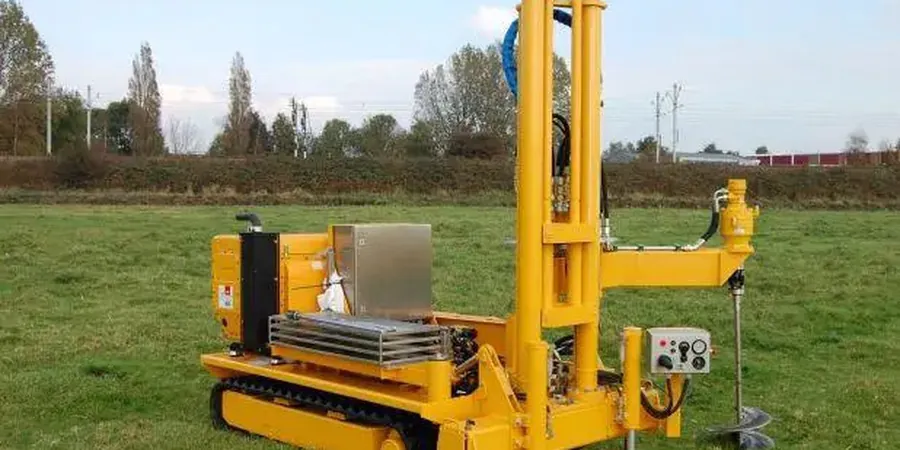
In the dense Halton Till that covers much of the Oakville plain, our 20-tonne rig typically reaches 15 to 22 metres before encountering refusal. South of the QEW in the glaciolacustrine clays, we can push to 30 metres or more. Refusal occurs when the cone hits the Queenston Shale bedrock or an extremely dense boulder lag within the till. We always push to refusal or the maximum depth specified in the investigation scope.
Do I need CPT or SPT for my Oakville project?
It depends on the ground conditions and what you need the data for. CPT provides a continuous profile and is excellent for detecting thin soft layers, estimating settlement, and characterizing soil behaviour type without sampling. SPT recovers a disturbed sample and is required when you need material for laboratory testing like grain size or Atterberg limits. On many Oakville sites, we combine a few CPT soundings with one or two boreholes to get the best of both methods.
How quickly can you mobilize a CPT rig to Oakville?
For projects within Oakville, we can typically have a rig on site within 48 hours of receiving a signed work order, subject to utility locates being cleared. Ontario One Call requires a minimum of five business days for public-side locates, so we advise clients to initiate that process early. Private utility locating is the contractor's responsibility and must be complete before we begin pushing.