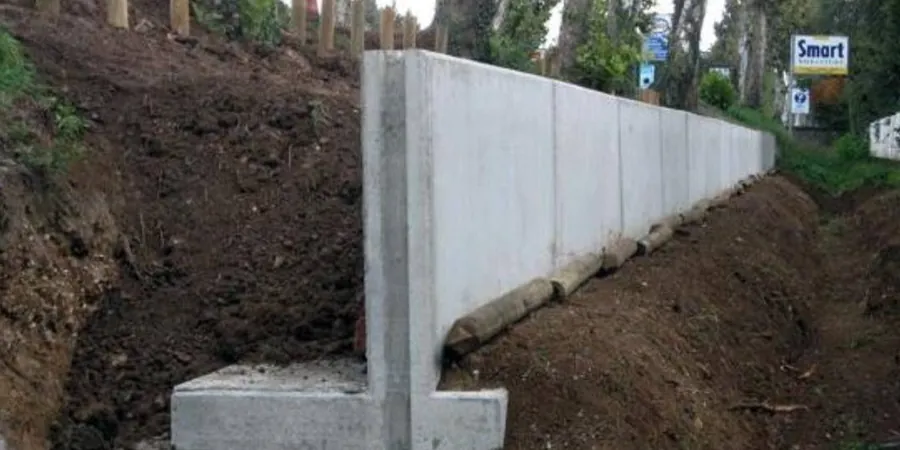
The geotechnical contrast between Oakville's lakeshore and its northern uplands shapes every retaining wall we design. Along the Lake Ontario shoreline, saturated silty clays and high groundwater tables demand solid cantilever or gravity walls with carefully engineered drainage. Head north toward the Niagara Escarpment, and the story shifts: here we encounter Queenston shale at shallow depths, often requiring drilled shafts or rock-anchored systems. Oakville's topography isn't uniform, and neither are its earth retention challenges. For a retaining wall design that holds up through freeze-thaw cycles and spring runoff, we start with a thorough subsurface investigation before a single structural calculation begins. Often this means pairing test pits to visually log the overburden with deeper SPT drilling where bedrock refusal is expected.
A retaining wall in Oakville is only as reliable as the drainage system hidden behind it—hydrostatic pressure doesn't negotiate.
Methodology and scope
Local considerations
Part 4 of the NBCC 2020 sets clear expectations for retaining wall stability, and in Oakville the combination of frost depth and shoreline geology makes these criteria particularly relevant. A wall without a proper foundation key or deep enough embedment in the Sixteen Mile Creek valley can fail progressively through toe erosion during a single major storm event. We've seen older dry-stack walls along private properties near Bronte Creek that are leaning forward after just a few winters. The culprit is usually a combination of poor compaction behind the wall and a clogged weep system. In our design reports, we model three failure modes: overturning, sliding, and bearing capacity loss. For tall walls in clayey soils, we also run a drained and undrained analysis—short-term stability during construction can be worse than long-term conditions. When bedrock is deep, sometimes a stone column ground improvement program makes more sense than a massive reinforced concrete wall.
Explanatory video
Applicable standards
NBCC 2020 – National Building Code of Canada, CSA A23.3-19 – Design of Concrete Structures, ASTM D698 – Standard Proctor (backfill compaction)
Associated technical services
Cantilever and Gravity Wall Design
Reinforced concrete stem walls and mass gravity walls engineered for residential and commercial grade changes, with full stability calculations.
Soldier Pile and Lagging Walls
Steel H-pile walls designed for tight access lots along Oakville's established neighborhoods, ideal where excavation space is limited.
MSE and Modular Block Systems
Mechanically Stabilized Earth solutions using geogrid reinforcement for larger retained heights, common in new subdivision developments north of Dundas Street.
Typical parameters
Frequently asked questions
What is the typical cost range for retaining wall design in Oakville?
For a standard residential retaining wall design, fees typically range from CA$1,480 to CA$5,230 depending on wall height, complexity, and the number of site visits required.
At what height does Oakville require a building permit and engineered design?
The Ontario Building Code requires a permit and professional engineering design for any retaining wall taller than 1.2 meters, or any wall supporting a surcharge like a driveway or structure.
How do you handle the Queenston shale bedrock during design?
We evaluate the top-of-rock elevation with borings. If the shale is weathered near the surface, we specify a keyway into competent rock. For high walls, rock anchors socketed into the shale can reduce the required footing width.
What drainage provisions do you include in the design?
Every design includes a continuous weeping tile at the base, a granular drainage chimney behind the wall, and filter fabric to prevent fines from clogging the drain. For clay backfill, we often increase the drainage layer thickness.