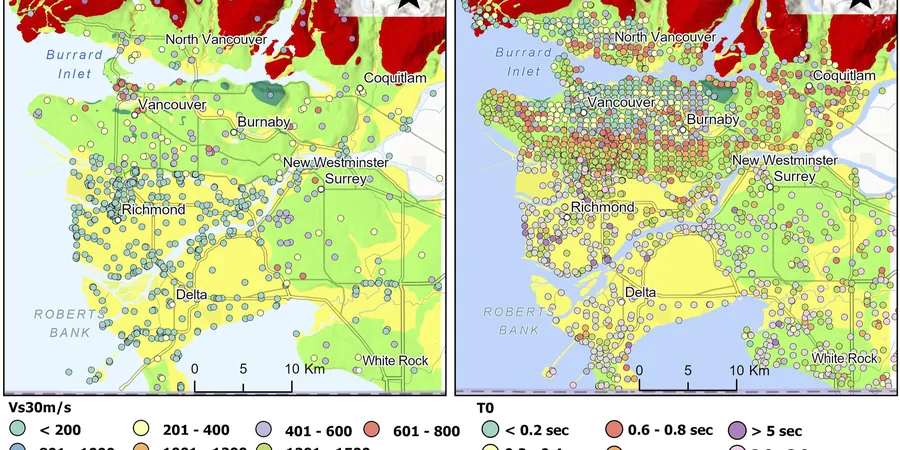
In Oakville, the difference in ground shaking during a moderate earthquake can vary dramatically between a site on the shale bedrock of the Niagara Escarpment and one over the deep buried valleys filled with soft Quaternary sediments south of Dundas Street. Our team has mapped these contrasts across Halton Region, observing that the forty-meter-thick deposits of glacial Lake Iroquois clays in sectors like Bronte can amplify long-period ground motion in ways that standard NBCC site class assignments often miss. This is why a site-specific seismic site response analysis tied to a detailed microzonation framework becomes essential, not just a regulatory checkbox. By integrating multi-channel surface wave testing with deep SPT drilling to confirm the stratigraphic column, we build a ground model that reflects the real impedance contrasts beneath your project, capturing the transition from the red Queenston Shale to the overlying Halton Till and lake deposits with the precision needed to inform structural design.
Mapping the buried bedrock valleys south of Upper Middle Road explains why two adjacent lots in Oakville can have fundamentally different seismic demands under NBCC 2015.
Methodology and scope
Local considerations
A developer working near the Ford plant understands the loading conditions of an industrial slab, but the seismic risk profile changes abruptly when the same structure is sited over a buried channel filled with twenty meters of soft clay versus a till sheet directly overlying bedrock. The Bronte Creek valley and the shoreline area near Coronation Park are zones where the thickness of soft sediments can exceed thirty meters, creating a resonance frequency that amplifies ground motion at periods critical for mid-rise buildings. Ignoring these lateral variations and applying a single site class across a large parcel is a technical shortcut that leads to either unconservative design or unnecessary over-engineering. Our microzonation work identifies these transitions with sufficient resolution so that the geotechnical and structural team can apply the correct spectral acceleration values to each building footprint, avoiding the uniform hazard trap that standard code application can create in a city with Oakville's stratigraphic complexity.
Explanatory video
Applicable standards
NBCC 2015 (Part 4, Seismic Design), CSA A23.3-14 (Design of Concrete Structures), ASTM D4428 (Crosshole Seismic Testing), ASTM D7400 (MASW), Eurocode 8 (EN 1998-1, for comparative amplification studies)
Associated technical services
MASW and Refraction Surveys
Active and passive surface wave arrays to measure shear-wave velocity profiles across the site, resolving the boundary between the Halton Till and the underlying Queenston Shale with precision.
Deep Boreholes with Downhole Seismic
Rotary sonic or hollow-stem auger borings to confirm stratigraphy, combined with downhole velocity measurements to calibrate the surface geophysics and provide a direct Vs profile through the overburden.
Site-Specific 1D Response Analysis
Non-linear equivalent-linear SHAKE or DEEPSOIL analysis using input motions matched to the NBCC 2015 uniform hazard spectrum for Oakville, producing surface spectra and amplification factors for each representative soil column.
Typical parameters
Frequently asked questions
How does a microzonation study differ from a standard site classification for seismic design?
A standard site classification assigns a single letter class (C, D, E) based on a Vs30 measurement or blow count estimate, which assumes a horizontally layered, uniform soil profile. A microzonation study maps how the ground response varies spatially across a larger site or neighborhood, identifying where the overburden thickness, impedance contrast, and resonance characteristics change. In Oakville, where the bedrock surface is irregular and buried valleys cut through the till, a single site class often misses the real variation in ground motion that a microzonation captures.
What is the typical cost range for a seismic microzonation study in Oakville?
Costs depend heavily on the site area, the density of measurements required, and the depth to competent bedrock. For a typical Oakville project, a microzonation study combining surface geophysics with a targeted drilling program ranges from CA$5,960 for a focused investigation on a small lot to CA$22,510 for a comprehensive mapping across a multi-hectare development parcel with complex buried valley stratigraphy.
What local geological features most influence seismic amplification in Oakville?
The two dominant features are the buried bedrock valleys, which can be filled with more than forty meters of soft glaciolacustrine clay and sand, and the transition from the shale bedrock of the Niagara Escarpment to the thick overburden near Lake Ontario. Both create strong impedance contrasts that amplify ground motion at specific frequency ranges, making a uniform site class assumption problematic.
Which NBCC site class applies to most areas of Oakville?
There is no single answer. Areas north of the QEW with shallow Halton Till over shale often classify as Site C, while the deep clay and sand deposits south of Cornwall Road toward the lake frequently fall into Site D or even Site E. The Oakville Moraine can present Site C conditions, but with a very different stratigraphic column. A microzonation maps these transitions explicitly.
What deliverables do we receive from a seismic microzonation project?
You receive a site plan with mapped shear-wave velocity contours, a series of representative soil profiles with their corresponding surface response spectra, amplification factor maps (Fa and Fv), and a technical report that discusses the stratigraphic controls on ground motion and provides clear design parameters for the structural engineer in accordance with NBCC 2015.