Oakville sits at an elevation of about 173 meters above Lake Ontario, and anyone who has excavated a foundation along the Dundas Street corridor or near the shores of Bronte Creek knows the soil is not just dirt—it’s a story of glacial retreat. The Halton till that blankets much of the town is a stiff, silty clay matrix with lenses of sand and gravel, and its behavior when wet or dry can make or break a project’s timeline. In our experience, the single most revealing test for these materials is a proper set of Atterberg limits. By quantifying the liquid limit, plastic limit, and plasticity index of the fine fraction, we can tell you exactly how the soil will react to seasonal moisture changes—critical in a town where spring thaw and autumn rains can turn a stable subgrade into a workability nightmare. This is not academic geology; it is the practical difference between a pavement that lasts twenty years and one that heaves apart in five. We often pair this analysis with a grain size evaluation to see the full picture of the matrix, especially when the till transitions into the underlying Queenston Formation shale.
The plasticity index is not just a number—it is the soil's biography, telling you how much water it has held since the glaciers left Oakville twelve thousand years ago.
Methodology and scope
Local considerations
A common mistake we see with smaller excavation contractors in Oakville is assuming that a stiff, dry clay till in August will behave the same way in November. We have walked onto sites off Trafalgar Road where the shoring was designed based on summer moisture conditions, only to find the soil’s liquid limit had been crossed after a week of rain, turning the base of the excavation into a slurry that compromised the formwork. If the Atterberg limits had been factored into the construction staging plan, the contractor would have known that the material’s liquidity index was dangerously close to 1.0 during the wet season. Ignoring these limits on a site with a high water table—common near the Lake Ontario shoreline—can lead to slope instability in open cuts and unforeseen delays. The cost of a few lab tests is trivial compared to the expense of re-excavating a collapsed trench or underpinning a settled foundation because the clay's plasticity was underestimated.
Explanatory video
Applicable standards
ASTM D4318-17e1, AASHTO T 89-13, OPSD/GDS (Ontario Provincial Standards), NBCC 2015 Div. B, Part 4 commentary
Associated technical services
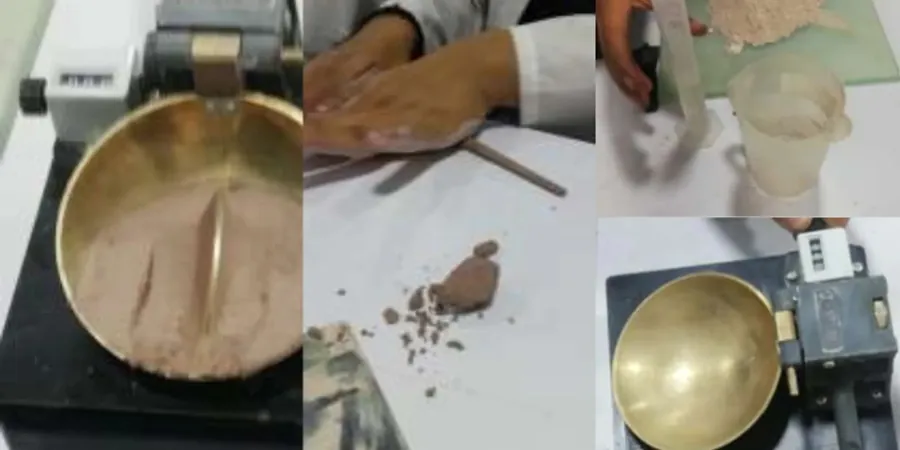
Standard Atterberg Limits Suite
Liquid limit, plastic limit, and plasticity index determination using ASTM D4318, with a detailed report classifying the soil according to the Unified Soil Classification System (USCS). Ideal for routine geotechnical investigations and pre-grading assessments.
Shrink-Swell and Activity Analysis
We correlate the plasticity index with the clay fraction from your grain size results to calculate the Skempton activity number, providing a direct estimate of the soil's volume change potential—a key input for foundation design in the Glenorchy and Morrison neighborhoods.
Construction-Phase Moisture Monitoring
Periodic re-testing of the Atterberg limits during earthworks to track changes in the soil's consistency due to weather or dewatering, ensuring that compaction specifications and subgrade preparation remain valid as site conditions evolve.
Typical parameters
Frequently asked questions
Why does Oakville clay need Atterberg testing if the till looks dry and stable?
The Halton till in Oakville is overconsolidated from glacial loading, which makes it appear very stiff when dry. However, its liquid limit can be relatively low, and once it absorbs water from spring melt or a broken watermain, it can soften rapidly. The Atterberg limits quantify this sensitivity, so your design team knows the moisture range where the soil transitions from a solid to a plastic state.
How much does Atterberg limits testing cost for a typical Oakville residential lot?
For a standard suite covering liquid limit, plastic limit, and plasticity index on a single sample, you can expect a cost in the range of CA$100 to CA$120. If multiple samples are required from different depths or boreholes across a larger subdivision parcel, we provide volume-based pricing that reduces the per-test rate.
Can you run Atterberg limits on samples that have been stored for a few weeks?
Yes, as long as the samples have been sealed to prevent moisture loss. We re-homogenize the material in the lab according to ASTM D4318 wet preparation procedures. The key is that the natural water content at the time of sampling was recorded; otherwise, the liquidity index cannot be accurately calculated, which limits the practical use of the results for construction planning.
What is the difference between the one-point method and the multi-point liquid limit test?
The multi-point test requires at least three trials at different moisture contents to define the flow curve, which is more statistically solid and is our standard procedure for all Oakville projects. The one-point method is sometimes used for preliminary screening in uniform materials, but for the heterogeneous Halton till, where clay content can vary significantly over short depths, we strongly recommend the full multi-point approach to avoid misclassification.