Every tunneling project in Oakville encounters the Halton Till and glaciolacustrine silty clays right from the start. A recent 600-meter utility tunnel near Bronte Creek required four boreholes to define the weathered shale interface, and another three to map an old buried channel. Without that level of detail, face collapse or excessive settlement becomes a real operational risk. Soft soil tunneling here means dealing with groundwater perched in sandy lenses and a variable bedrock surface that dips toward Lake Ontario. That is why our geotechnical analysis for soft soil tunnels integrates field investigation, laboratory strength testing, and numerical modeling before the first shove of the TBM. Supplementing the investigation with an SPT drilling program helps establish the N-value profile through the till, while in-situ permeability tests quantify the hydraulic conductivity of the interbedded sands that often cause unexpected inflows during advance.
Accurate soft-ground characterization in Oakville's glaciolacustrine clays can reduce tunneling risk by 40% compared to designs based solely on regional correlations.
Methodology and scope
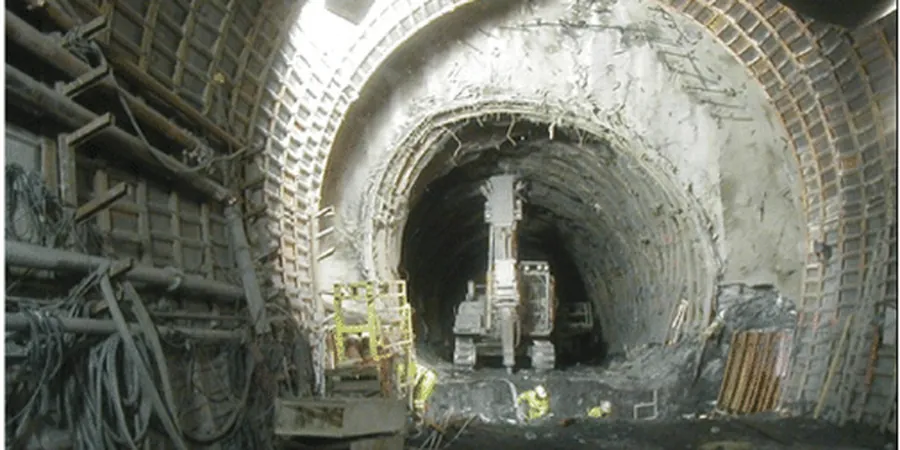
Local considerations
Oakville’s rapid expansion along the Dundas Street corridor and the North Oakville development area has pushed infrastructure into zones where the overconsolidated clay crust is thinner and more sensitive. Tunneling through these soft soil deposits without proper geotechnical analysis introduces significant risks: face instability in the weathered shale transition, long-term consolidation settlement that damages surface structures, and groundwater drawdown that affects residential wells. The 2019 Sixteen Mile Creek trunk sewer project highlighted how a misinterpreted buried valley fill can lead to a 30 percent cost overrun in ground improvement measures. Our approach quantifies the probability of face collapse using limit equilibrium methods and estimates maximum surface settlement under drained and undrained conditions, taking into account the stress history of the Oakville clay.
Applicable standards
ASTM D4767-11 (Consolidated Undrained Triaxial Compression Test), NBCC 2020 Division B, Part 4, ASTM D2435/D2435M-11 (One-Dimensional Consolidation Properties), CSA A23.3-14 (Design of Concrete Structures, relevant for tunnel linings), ITIG (International Tunneling and Underground Space Association) Guidelines for Soft Ground Tunneling
Associated technical services
Pre-Construction Ground Investigation
Rotary sonic and hollow-stem auger drilling to recover continuous Shelby tube samples, combined with downhole geophysics for bedrock profiling across the tunnel alignment.
Advanced Laboratory Testing Program
Triaxial CIU, CRS consolidation, and K0-consolidated testing suites designed to extract stiffness degradation curves and small-strain shear modulus (Gmax) for FEM inputs.
Tunnel Stability and Settlement Analysis
2D and 3D finite difference modeling (FLAC/PLAXIS) to predict face extrusion, ground loss, and the settlement trough shape under different excavation sequences and support pressures.
Typical parameters
Frequently asked questions
What is the typical depth of the soft clay layer in Oakville?
In most of Oakville south of Dundas Street, the glaciolacustrine clay unit extends from about 2 meters below grade down to 12–18 meters, where it transitions into the Queenston Shale bedrock. Near the Lake Ontario shoreline and along some creek valleys, the clay can be thinner or absent where erosion has removed the overburden. A detailed borehole program is the only way to confirm the exact depth at your site.
How much does a soft soil tunnel analysis cost for a standard utility project?
For a typical municipal sewer or watermain tunnel in Oakville, a comprehensive geotechnical analysis including field investigation, lab testing, and settlement modeling ranges from CA$6,000 to CA$20,040 depending on the length of the alignment, the number of boreholes required, and the complexity of the surface structures above the tunnel.
Which tunneling method works best in Oakville's clay?
Earth Pressure Balance (EPB) TBMs have performed well in the Halton Till and glaciolacustrine clays of southern Ontario. The key is maintaining face pressure slightly above the in-situ earth pressure to control settlement. For short drives or large-diameter shallow tunnels, sequential excavation methods with spiling and shotcrete lining can be effective, provided the stand-up time is verified through CPT pore pressure dissipation data.
How do you account for the stiff clay becoming soft near the shale interface?
The transition zone above the Queenston Shale is often a water-bearing, softened clay layer due to historic weathering. We specifically target this interface during drilling and perform undrained triaxial tests on samples from that depth. The reduced shear strength in this zone is incorporated into our face stability calculations, and we typically recommend a conservative support pressure profile that increases as the TBM approaches the bedrock contact.