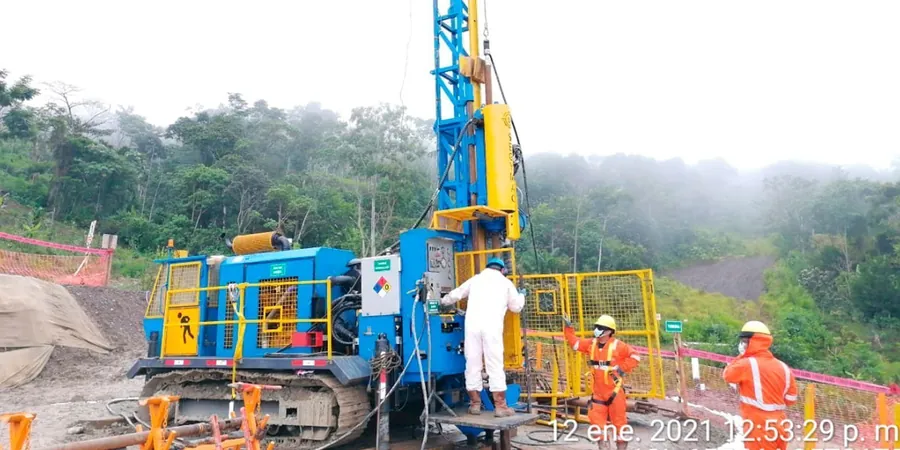
Oakville's subsurface tells a story that varies dramatically between the lakeshore and the escarpment. Down near Bronte Harbour, you're often dealing with loose sands and soft silts that give an SPT N-value barely reaching 5 or 6 in the first few meters, while up in Glen Abbey the till tightens up fast and you're hitting N-values above 30 by the time you reach three meters. That contrast means a foundation designed for one part of town won't necessarily work in another. The Standard Penetration Test gives us a repeatable, numbers-driven way to map that transition, recording the resistance every 1.5 meters as the sampler is driven into the ground. Grain-size analysis in the lab helps us verify whether those low blow counts are tied to saturated silts or something more stubborn, and a CPT test can be useful when you need continuous profiling through layered deposits without missing thin soft seams.
Corrected SPT N-values are the difference between a footing that performs for decades and one that differential settlement cracks in five years.
Methodology and scope
Local considerations
Contractors working along the Lakeshore Road corridor sometimes assume that a handful of boreholes with consistent N-values means the whole site is uniform. That assumption backfires when they encounter buried creek channels—there are several old tributaries of Sixteen Mile Creek that got filled and built over decades ago, and the fill is loose, heterogeneous, and gives SPT counts in the single digits right next to competent native till. If those pockets aren't caught, the foundation can settle unevenly and you're into underpinning before the framing is even complete. The other mistake we see involves ignoring groundwater correction in fine sands below the water table—uncorrected N-values can read artificially high due to pore pressure buildup at the sampler tip. Running liquefaction assessment using Youd-Idriss (2001) methods on those corrected SPT numbers is standard practice now for any mid-rise near the lake, and skipping it is a liability no geotechnical engineer wants to carry.
Explanatory video
Applicable standards
ASTM D1586-18 — Standard Test Method for Standard Penetration Test (SPT) and Split-Barrel Sampling of Soils, NBCC 2020 — National Building Code of Canada (seismic provisions, site classification), CSA A23.3-19 — Design of Concrete Structures (foundation references)
Associated technical services
SPT-Based Foundation Design Parameters
We correlate corrected N60 values with drained friction angle and undrained shear strength using published relationships (Hatanaka & Uchida, Peck, etc.) to generate bearing capacity recommendations that account for Oakville's layered stratigraphy.
Seismic Site Classification (NBCC)
Using average N60 over the upper 30 meters, we assign a Site Class per NBCC 2020 Table 4.1.8.4.A. This feeds directly into the structural engineer's seismic demand calculations for new builds in the region.
Typical parameters
Frequently asked questions
How long does an SPT investigation take for a typical Oakville residential lot?
For a standard single-family lot with two to three boreholes reaching 10 to 15 meters, field work usually wraps up in one day. The lab testing and reporting phase adds about a week to ten days, depending on how many samples need grain-size or Atterberg analysis.
What depth do you drill for SPT testing in Oakville?
It depends on the site location. In south Oakville near the lake, we often go to 15 or 20 meters to get through soft deposits and into competent till. In north Oakville, where bedrock can be shallow, 5 to 10 meters is more typical. We always extend boreholes at least 3 meters into competent bearing stratum.
What is the typical cost range for SPT testing in Oakville?
Most investigations fall between CA$740 and CA$1,070 per borehole, which includes mobilization, drilling, sampling, field logging, and the geotechnical report. The final figure depends on depth, access conditions, and the number of lab tests requested.
Do you handle utility locates before drilling?
We coordinate with Ontario One Call to have public utilities marked before any drilling begins. For private utilities—gas lines to a pool heater, buried electrical to a garage—the property owner or contractor needs to arrange a private locate. We won't break ground until the clearance is confirmed.