Underground excavations in Oakville demand a rigorous understanding of the local Queenston Shale and overburden soils, where groundwater and weathered rock interfaces often dictate stability. Our approach integrates Ontario Building Code requirements and Canadian Foundation Engineering Manual guidelines to manage risks in soft ground. Early-phase geotechnical analysis for soft soil tunnels is essential to predict settlement and face stability, while comprehensive geotechnical design of deep excavations ensures shoring and base heave are controlled within the tight tolerances typical of urban Oakville sites.
These services directly support municipal sewer and watermain tunnels, below-grade parking structures, and cut-and-cover transit corridors where adjacent heritage buildings or lakefill deposits impose strict deformation limits. Continuous geotechnical excavation monitoring closes the loop, validating design assumptions and protecting surrounding infrastructure throughout construction.
A passing anchor test isn’t just about hitting the jack pressure; it’s about a flat creep curve over 60 minutes in Oakville’s sensitive clays.
Methodology and scope
Local considerations
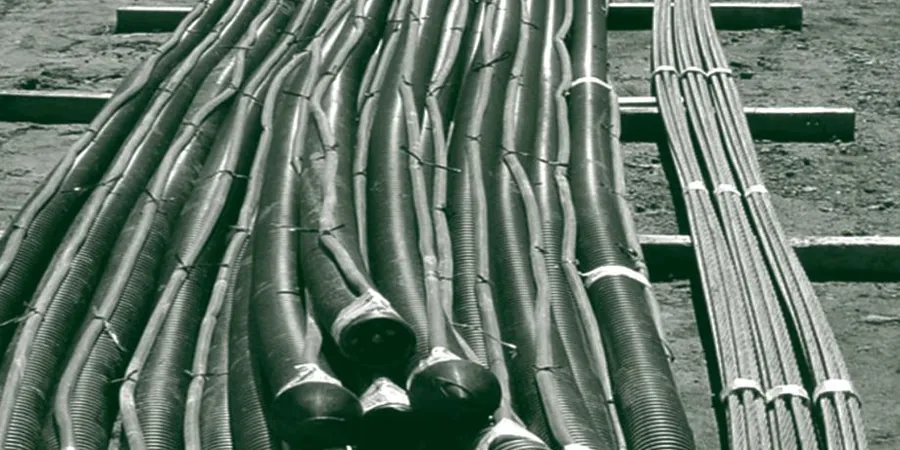
One of the things we see repeatedly in Oakville is the delay between drilling the anchor hole and grouting it. In the shale of the Georgian Bay Formation, the borehole wall can soften within hours if left open to water. The result is a bond zone that looks fine during drilling but delivers half the expected pull-out capacity. Another risk shows up on sites near Sixteen Mile Creek, where groundwater levels fluctuate seasonally. A permanent anchor designed for a dry winter condition might see hydrostatic pressure against the bond zone in April, reducing effective stress. We always recommend a pre-production anchor test program: at least three sacrificial anchors loaded to failure to confirm the ultimate bond stress before the production anchors go in. It costs a few days, but it’s far cheaper than redesigning the shoring after excavation has started. Creep failure in passive anchors is less dramatic but just as real; we’ve measured slow displacement in clay bond zones under sustained dead load that would have gone unnoticed without a dial gauge.
Explanatory video
Applicable standards
CSA A23.3:19 – Design of Concrete Structures (Annex G for anchor testing), PTI DC35.1-20 – Recommendations for Prestressed Rock and Soil Anchors, ASTM D4435-13 – Rock Bolt Anchor Pull Test, ASTM D3689 / D3966 – Pull-Out Resistance of Tiebacks, NBCC 2015 Div. B Part 4 – structural loads for permanent anchors
Associated technical services
Pre-Production Anchor Pull-Out Testing
We install and test sacrificial anchors to determine the ultimate bond stress in the specific stratum on your Oakville site. Load is applied in increments with real-time creep monitoring.
Proof and Performance Testing
Every production anchor is proof-tested to 133% of design load per CSA A23.3. We record load-extension curves and creep rate, providing a stamped report within 24 hours.
Bond Zone Shear Strength Lab Program
Triaxial UU and CU tests on undisturbed samples extracted from the anchor bond length, paired with moisture content and Atterberg limits, to correlate lab data with field pull-out results.
Typical parameters
Frequently asked questions
What’s the difference between an active and a passive anchor?
An active anchor is tensioned to its design load immediately after installation and locked off against the bearing plate; that preload actively compresses the soil or rock mass. A passive anchor is not tensioned at installation—it only develops resistance once the structure moves enough to stretch the tendon. In Oakville’s till, active anchors are the norm for shoring because they limit lateral movement from day one.
How much does anchor testing cost in Oakville?
For a project in the Halton Region, anchor testing typically ranges from CA$1,370 to CA$5,700 depending on the number of anchors, access conditions, and whether it’s a pre-production or proof test program. The spread covers a single verification test on up to a full day of production anchor proof testing with load cell and dial gauge setup.
How long does the crew need on site for a proof test?
Plan on about one hour per anchor once the jack and reference beam are set up. The load-hold sequence for a proof test to 133% typically requires 30 to 60 minutes of monitoring, plus time for setup and takedown. For a program of 10 anchors in Oakville, we can usually complete the work in a single day.