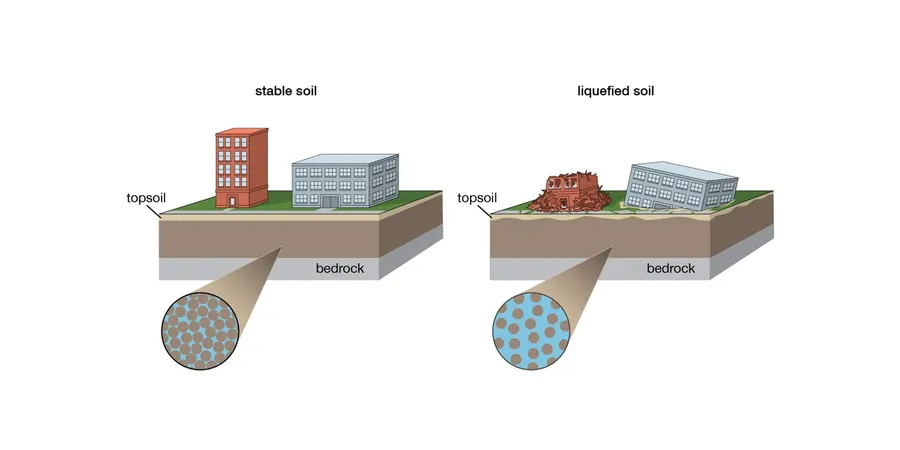
The north shore of Lake Ontario hides a geotechnical challenge that surprises many developers in Oakville—saturated, loose sands deposited by glacial Lake Iroquois. When you combine a high water table with the fine-to-medium sands common in the Kerr Village and Bronte areas, you get a textbook setting for soil liquefaction. Even though Oakville sits in a moderate seismic zone under the NBCC 2020, the lake-moderated microclimate keeps the ground moist nearly year-round, which raises the risk profile for any project with a basement or deep utility corridor. We routinely pair our CPT testing with laboratory cyclic triaxial work to quantify the factor of safety against liquefaction before shovels hit the ground. For taller structures near the downtown core, the analysis feeds directly into the seismic microzonation parameters required by the town’s building department.
Saturated clean sand under a high water table doesn’t need a major earthquake—even a moderate event can trigger excess pore pressure and settlement in Oakville’s lakeshore neighbourhoods.
Methodology and scope
Local considerations
Under the Ontario Building Code, which references the NBCC 2020 for seismic provisions, any site with a liquefiable layer thicker than 150 mm must be evaluated for post-earthquake settlement and lateral spreading. This hits Oakville hard because the creeks—Sixteen Mile, Fourteen Mile, and Bronte Creek—carved valleys that are now lined with loose Holocene alluvium. A building on a shallow footing near a creek bank isn’t just dealing with vertical settlement; it faces the possibility of lateral displacement toward the open face. Our reports quantify both the settlement under the design earthquake and the residual strength of the liquefied soil for slope stability checks. When the factor of safety drops below 1.1, we don’t just flag it—we run a deformation analysis to see if the structure can tolerate the movement, or if ground improvement becomes mandatory. Ignoring this step has led to differential settlements exceeding 100 mm in other Great Lakes shoreline projects, a number that cracks brick veneer and shears underground services.
Applicable standards
NBCC 2020 (National Building Code of Canada, seismic provisions), ASTM D1586-18 (Standard Test Method for SPT), ASTM D5311/D5311M-13 (Cyclic Triaxial for Liquefaction), Youd et al. (2001) NCEER/NSF workshop recommendations, Ontario Building Code O.Reg. 332/12
Associated technical services
Liquefaction Triggering & Settlement Analysis
We use SPT, CPT, and Vs data to calculate the factor of safety against liquefaction at each borehole. The output includes post-liquefaction settlement estimates and lateral spreading potential for sites within 200 m of a creek or the lake.
Ground Improvement Design for Liquefaction Mitigation
When the native sand fails the safety check, we design stone columns, vibrocompaction, or compaction grouting programs. The design targets a post-treatment SPT N-value or tip resistance that brings the factor of safety above 1.3 for the design earthquake.
Typical parameters
Frequently asked questions
Does Oakville’s seismic hazard really justify a liquefaction study?
For most low-rise residential, the answer used to be no. But with the NBCC 2020 update and the town’s push toward mid-rise intensification along Lakeshore and Trafalgar, any building over three storeys or with a deep basement on saturated sand now triggers the requirement. The peak ground acceleration may be moderate, but the water table near the lake is high enough that loose sand layers can still liquefy.
What’s the difference between a screening-level and a full liquefaction analysis?
A screening uses SPT blow counts and grain size to apply simplified procedures like Youd et al. (2001). If the factor of safety is above 1.5, we stop there. A full analysis adds cyclic triaxial testing on undisturbed samples, site response modelling, and settlement/displacement calculations—required when the factor of safety falls between 1.0 and 1.5.
How much does a liquefaction study cost in Oakville?
A combined SPT-based liquefaction screening with grain size lab work typically falls between CA$3,540 and CA$6,130, depending on the number of boreholes and whether cyclic triaxial testing is needed. Projects requiring CPT soundings or MASW surveys will land at the upper end of that range due to specialized equipment mobilization.
Can you do the investigation in winter when the ground is frozen?
Yes, we drill year-round in Oakville. Frozen ground slows the top metre or two, but the liquefiable sands at 3–12 metres are below the frost line. We use a tracked rig with a heated enclosure when needed, and the split-spoon samples come out just fine. The main constraint is keeping the drilling water from freezing on very cold days.