In Oakville, the performance of any pavement—from the residential streets of Glen Abbey to the heavy-duty loading docks of the Ford plant—hinges on what lies beneath the asphalt. Many local projects encounter the silty clay till of the Halton region, a material that can lose significant strength with changes in moisture content. Rather than guessing, the laboratory CBR test provides a direct measurement of the subgrade’s bearing capacity under controlled conditions. This value is the foundation of the AASHTO 93 pavement design method, which Ontario municipalities commonly reference. For projects near the Lake Ontario shoreline, where groundwater is perched and soils are often close to saturation, we typically pair the CBR with a grain-size analysis to fully characterize the material’s drainage potential. The result is a pavement section that meets the Town of Oakville’s engineering standards without unnecessary over-excavation or imported granular costs.
A 96-hour soaked CBR test on Oakville’s Halton Till often reveals a strength reduction of 40-60% compared to its as-compacted state, a factor that no pavement design can afford to ignore.
Methodology and scope
Local considerations
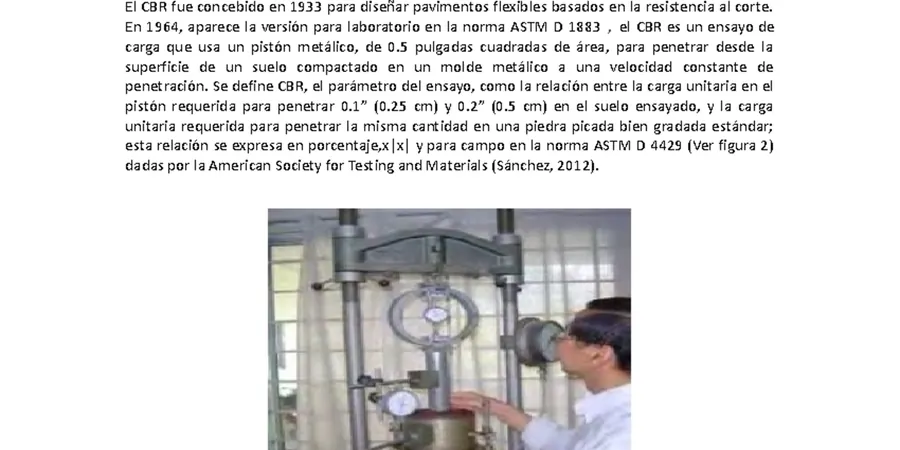
The laboratory CBR test uses a rigid loading frame to drive a standard 1.954-inch diameter piston into the compacted soil specimen at a constant rate. The risk we mitigate is not related to the machinery itself, but to the misapplication of the results. A common mistake in Oakville is assuming that a high unsoaked CBR from a summer compaction test will hold through the spring thaw. The water table in areas like Bronte Creek or Morrison can rise significantly, fully saturating the subgrade. If the pavement structure was designed using an optimistic, low-moisture CBR value, the result is rutting, alligator cracking, and premature failure within three to five years—a costly consequence for any developer or commercial property owner. Our report explicitly states whether the design CBR should be based on the soaked value, and we note the swell potential, which can lift a lightly loaded parking lot slab if not accounted for. We recommend performing a site-specific CBR correlation with a dynamic cone penetrometer when in-situ verification is required across variable terrain.
Applicable standards
ASTM D1883-21: Standard Test Method for California Bearing Ratio (CBR) of Laboratory-Compacted Soils, ASTM D1557-12: Standard Test Methods for Laboratory Compaction Characteristics of Soil Using Modified Effort, OPSS 1010: Material Specification for Aggregates – Base, Subbase, Select Subgrade, and Backfill Material
Associated technical services
Soaked and Unsoaked CBR Determination
Full ASTM D1883 testing with 96-hour soak and swell measurement. We provide the corrected CBR values at both 0.1-inch and 0.2-inch penetration for direct input into the AASHTO 93 pavement design equation, along with the unit weight and moisture content of the compacted specimen.
Pavement Material Compliance Package
Combined Proctor compaction curve, laboratory CBR, and gradation analysis for granular base and subbase materials. This package satisfies the Town of Oakville’s submission requirements for new subdivision roads and commercial site plans, ensuring the imported material meets OPSS 1010 specifications before placement.
Typical parameters
Frequently asked questions
What is the cost of a laboratory CBR test in Oakville?
A single-point laboratory CBR test, including specimen compaction at modified Proctor energy and a 96-hour soak, typically ranges from CA$150 to CA$250. The final price depends on whether we are testing native subgrade soil or imported granular base material, and if a companion Proctor test is required to establish the compaction curve.
How long does it take to get CBR results?
The standard turnaround is five to seven business days. The soaking phase alone requires 96 hours per ASTM D1883. After soaking, we run the penetration test, dry the specimen for moisture content, and prepare the report. Expedited reporting can be arranged for projects on a tight construction schedule in Oakville.
Why is the soaked CBR value so much lower than the unsoaked one?
When a compacted soil is submerged, water fills the void spaces and reduces the effective stress between particles. In Oakville’s silty till, the fines soften and lose cohesion, which drastically reduces the penetration resistance. The soaked value represents the worst-case scenario after heavy rain or spring melt, and it is the value that governs pavement thickness design in Ontario.
Do I need a laboratory CBR test or can I use a field DCP test?
For municipal submissions in Oakville, the laboratory CBR is often the referenced value for structural design. However, a Dynamic Cone Penetrometer (DCP) test is excellent for verifying the in-situ uniformity of the compacted layer. We recommend using the lab test to establish the baseline CBR-moisture-density relationship, and the DCP for quality control during construction to confirm that the placed material meets the design strength.