The contrast between the silty clay till capping the Iroquois Plain in South Oakville and the shale bedrock near the Niagara Escarpment in the north means that fill behavior is never uniform across town. A sand cone density test often follows our lab work when field verification is needed on compacted lifts, but the starting point is always the moisture-density relationship. In Bronte, near the lake, we encounter wet cohesive soils that demand precise moisture conditioning to reach specified density, while in Glen Abbey the crushed shale used as structural fill has a completely different compaction curve. Our lab on the South Service Road processes these samples with the ASTM D698 and D1557 procedures that Ontario’s MTO and most Oakville geotechnical reports require, delivering the maximum dry density and optimum moisture content that site supervisors need before a single compactor starts rolling.
A one percent deviation in moisture from optimum can cost you 5 percent in dry density – in Oakville's silty tills, that gap widens fast.
Methodology and scope
Local considerations
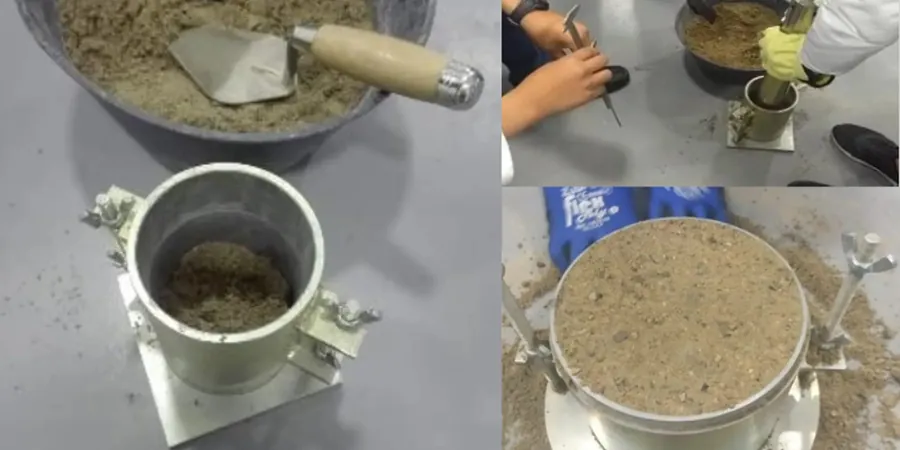
The split mold and the 5.5 lb hammer sitting on our lab bench look simple, but the error budget in this test is unforgiving. If the technician does not trim the collar flush with the mold rim — a single stroke of the straightedge across a silty Halton Till that crumbles at the edges — the calculated density shifts by two or three pounds per cubic foot. In Oakville, where the natural moisture in spring can sit three percent above optimum, we have to air-dry samples under a fan and remix them in stages, because oven-drying the whole batch collapses the clay structure and you end up chasing a curve that does not match field behavior. The other trap is oversized particles: when a gradation shows more than five percent retained on the ¾-inch sieve, the lab either scalps the sample or switches to a 6-inch mold per ASTM D4718, and if that correction is not applied, the field spec becomes impossible to meet. We run at least four points to define each curve, rejecting any test where the peak is not bracketed by two points on the wet side.
Applicable standards
ASTM D698-12(2021) – Standard Proctor, ASTM D1557-12(2021) – Modified Proctor, ASTM D4718 – Oversize Correction, MTO LS-706 / LS-707, OPSS 206 and OPSS 501
Associated technical services
Standard Proctor (ASTM D698)
The baseline compaction curve for residential backfill, utility trenches, and low-energy compaction equipment. Uses 5.5 lb hammer over 3 layers.
Modified Proctor (ASTM D1557)
Required for structural fill under footings, road sub-base along Regional roads, and any project using heavy vibratory rollers. 10 lb hammer over 5 layers.
Oversize Correction (ASTM D4718)
Applied when the sample has more than 5 percent retained on the ¾-inch sieve, a common scenario in Oakville's shale fills and recycled concrete blends.
Field Compaction Correlation
We pair the Proctor curve with nuclear gauge or sand cone data from the site to calculate percent compaction relative to the lab maximum, giving the inspector a clear pass/fail for each lift.
Typical parameters
Frequently asked questions
What is the cost of a Proctor test in Oakville?
A single-point Proctor test (standard or modified) typically ranges from CA$120 to CA$270 depending on whether we need to run the full four-point curve or a one-point verification against an existing family of curves. If an oversize correction is required, that adds a small surcharge. We can give you a firm number once we know the material type and the specification you are working to.
How much sample do I need to bring to the lab?
For a standard Proctor we ask for at least 20 kg of representative soil. For a modified Proctor, plan for 35 kg minimum, especially if the material contains gravel-sized particles that may require the oversize correction. Double-bag the sample to preserve field moisture, and bring it to our South Service Road lab during business hours.
Which method should I specify for my project in Oakville?
It depends on the compaction equipment and the end use. Most residential backfill and trench work in Oakville uses the standard Proctor (ASTM D698). Road sub-base, commercial building pads, and any fill compacted with a smooth-drum vibratory roller over 5 tonnes should use the modified Proctor (ASTM D1557). When in doubt, check the project specification or ask the geotechnical engineer of record.
How long does the test take?
A full four-point curve takes about one working day from the time we receive the sample at field moisture. If the soil needs air-drying to reduce the natural water content, which is common with Oakville's spring and fall conditions, add half a day. We can often expedite results for an active site if you call ahead.
What happens if the field density does not match the lab curve?
It usually points to one of three things: the fill material has changed from the sample we tested, the moisture content on site is too far from optimum, or oversized particles are throwing off the comparison. We can run a gradation check and a one-point verification on a new sample to diagnose the mismatch and recommend adjustments to the compactive effort or moisture conditioning.