In Oakville, groundwater control makes or breaks a project. The variable overburden of Halton till over Queenston shale means permeability can shift drastically within a single site. ASTM D4630 governs our field testing, providing the in-situ hydraulic conductivity values engineers need for dewatering system design or grouting evaluation. Whether it's a deep excavation near the QEW or a foundation in the Morrison Creek valley, guessing at permeability leads to cost overruns and schedule delays. We run both Lefranc tests in soil and Lugeon tests in rock, giving you formation-specific data you can rely on. Complementing this with a CPT investigation often clarifies the stratigraphy before setting test intervals. For projects in the Iroquois Shoreline area, where sand layers sit above till, we frequently combine permeability testing with grain size analysis to correlate field results with material properties.
In Oakville's layered till and shale, a one-size-fits-all permeability assumption costs more than the test itself.
Methodology and scope
Local considerations
Oakville's geology doesn't read textbooks. The Halton till matrix is dense but cut by sand lenses and fractures that create preferential flow paths. A single borehole permeability test that misses a sand seam can underestimate site-wide inflow by an order of magnitude. In the Queenston shale, Lugeon values often decrease with depth as fractures close under overburden pressure, but near-surface weathered zones can take significant water. The Iroquois Shoreline deposits south of Rebecca Street add complexity: coarse sands and gravels here transmit water rapidly, complicating deep excavations. Underestimating permeability leads to flooded pits, base instability, and sediment transport fines clogging dewatering wells. Our test programs target the critical horizons, not just the average. For environmental work, accurate K values determine contaminant migration rates and the sizing of interception trenches.
Applicable standards
ASTM D4630-19, USBR Earth Manual Part 2, ISO 22282-2:2012, MTO Laboratory Testing Manual
Associated technical services
Lefranc Test (Soil)
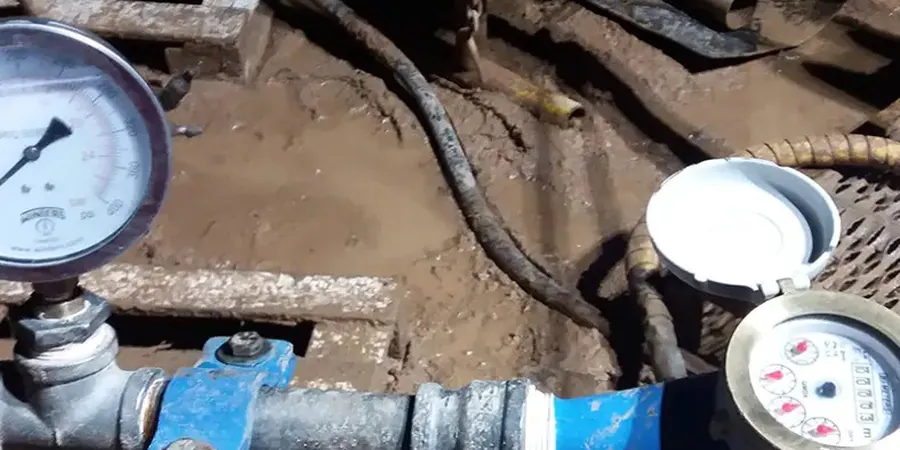
Constant or falling head tests in soil boreholes. We isolate the test section with packers, measure flow rates, and calculate hydraulic conductivity per Hvorslev or USBR methods. Ideal for till, sand lenses, and weathered shale in Oakville.
Lugeon Test (Rock)
Pressurized water testing in fractured Queenston shale or dolostone. The five-stage pressure cycle assesses fracture dilation and rock mass permeability. Essential for grouting design and tunnel inflow estimates.
Typical parameters
Frequently asked questions
What's the typical cost for a Lefranc or Lugeon test in Oakville?
Budget between CA$730 and CA$1,310 per test, depending on depth, number of intervals, and whether we're testing in soil or rock. A full site investigation with multiple tests and packer setups runs higher. We'll scope the program to match your dewatering or grouting requirements without padding the bill.
How deep do you typically test in Oakville's geology?
Most projects need data from 3 to 15 meters below grade. For basements in the till plain, Lefranc tests at 3, 6, and 9 meters usually capture the critical horizons. Deep excavations near the escarpment or along the QEW corridor may require Lugeon testing to 20 meters or more into the Queenston formation.
How many tests do I need for my site?
We scope based on site size and stratigraphic variability. A single-family lot might need three Lefranc tests. A commercial excavation across the Iroquois shoreline deposits could require a grid of tests in both sand and till. We'll review your geotechnical report and recommend a program that satisfies both MTO and municipal reviewers.