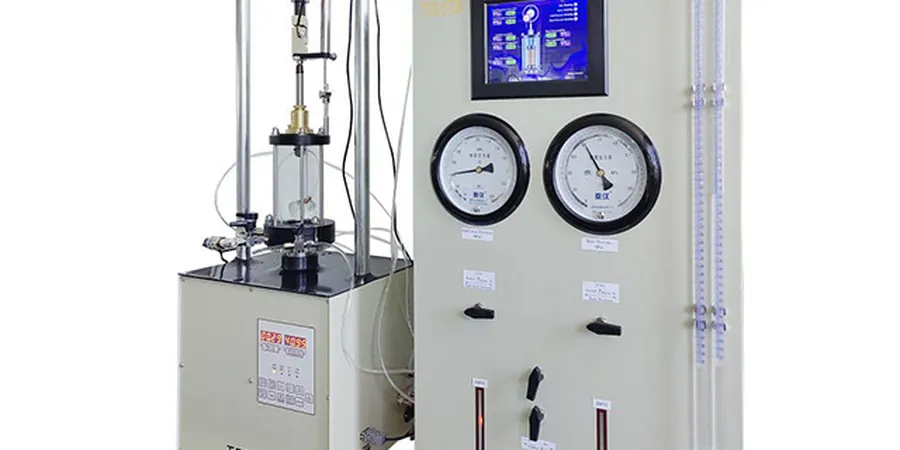
A triaxial cell sitting on the bench of a GCTS load frame is a distinct piece of kit. Inside that transparent chamber, a soil specimen sheathed in a rubber membrane gets subjected to exactly the kind of stress it will feel thirty feet below a Oakville basement or under a bridge abutment on the QEW. The confining pressure mimics the lateral squeeze of the surrounding ground, while the axial piston pushes down to failure. That’s what separates a triaxial test from simpler index methods. For sites in southeast Oakville with their glaciolacustrine silts, or up on the Halton Till plain, getting the effective stress parameters right is the difference between an overdesigned footing and one that barely meets the Ontario Building Code. We run these tests in our accredited lab, and the data feeds directly into the bearing capacity and settlement models your geotechnical engineer relies on. For preliminary site characterization, we also pair this with grain-size analysis to correlate the silt-clay fraction with the drained shear response.
Effective stress parameters from a CU triaxial test tell you what the ground really contributes to stability, not just what the water pressure allows.
Methodology and scope
Local considerations
Oakville has grown fast, and not all the land developed in the last three decades got the deep geotechnical review it deserved. Older subdivisions along creeks like Fourteen Mile or Sixteen Mile were built on compacted fill over alluvial deposits. Compaction alone doesn’t change the drained shear strength parameters, and those parameters control slope stability over the long haul. If you’re adding a story to a 1990s home near the lake or putting a townhouse block on a redeveloped lot, assuming the soil’s shear strength from a standard penetration test correlation is a gamble. A triaxial test on an undisturbed sample measures the actual effective cohesion and friction angle. With those numbers, a slope stability analysis using Spencer’s method will actually tell you whether that existing retaining wall is adequate or if the next heavy rain could trigger a slide. The cost of the test is trivial compared to stabilizing a failed slope.
Applicable standards
ASTM D4767-11 – Standard Test Method for Consolidated Undrained Triaxial Compression Test for Cohesive Soils, ASTM D2850-15 – Standard Test Method for Unconsolidated-Undrained Triaxial Compression Test on Cohesive Soils, Canadian Foundation Engineering Manual (CFEM) 4th Ed., Ontario Building Code (OBC) Div. B, Part 4
Associated technical services
Consolidated-Undrained (CU) Testing
CU triaxial tests with back-pressure saturation and pore pressure measurement. Provides effective stress parameters (c', φ') for long-term stability and drained bearing capacity calculations.
Unconsolidated-Undrained (UU) Testing
Quick-turnaround UU tests for short-term construction conditions. Gives the undrained shear strength (Su) needed for excavation support design and temporary works in clay.
Drained (CD) Shear Testing
Slow, drained tests for coarse-grained soils and long-term settlement evaluation. Establishes the critical-state friction angle for use in advanced constitutive models.
Triaxial Interpretation & Reporting
Full engineering report with stress-strain curves, Mohr-Coulomb failure envelopes, Skempton’s pore pressure coefficients, and recommendations for design parameters.
Typical parameters
Frequently asked questions
How much does a triaxial test program cost in Oakville?
A single triaxial test typically costs between CA$2,330 and CA$3,780, depending on the type: UU tests are at the lower end of the range, while CU tests with pore pressure measurement and CD tests fall at the higher end due to the longer testing duration. Most projects require a suite of three specimens to define the Mohr-Coulomb failure envelope.
What sample quality is needed for a reliable triaxial test?
The test is only as good as the sample. We need undisturbed samples taken with Shelby tubes or block sampling methods. For the soft glaciolacustrine silts common in parts of Oakville, we aim for a sample disturbance classification of Class 1 or 2 per the Lunne criteria. Highly disturbed samples (Class 3 or 4) produce unconservative strength parameters and should be avoided for CU or CD testing.
When should I specify a CU test instead of a UU test?
Specify a CU test when you need effective stress parameters for long-term stability analyses, such as permanent retaining walls, slope stability after construction, or settlement calculations where pore pressures will dissipate over time. UU tests are appropriate for short-term construction conditions in low-permeability soils where the loading happens faster than water can drain.
How long does a triaxial test take to complete?
A UU test can be completed in a day. A CU test with pore pressure measurement typically takes three to five days, including saturation, consolidation, and the shearing stage. CD tests on fine-grained soils can run for seven to ten days. We always discuss the project schedule upfront so the test program aligns with your design milestones.