The contrast between a century home near Lakeshore Road in Old Oakville and a new build on the Halton Till uplands north of Dundas is stark, and it starts at the footing. In the south, shallow foundations frequently bear on dense Queenston Shale only a metre below grade, giving you high allowable pressures with minimal excavation. Move two kilometres north into the Glen Abbey area and the same footing encounters stiff silty clay over glacial till, where bearing capacity drops and seasonal moisture becomes the controlling factor. We approach shallow foundation design in Oakville by first mapping these transitions, then sizing footings to match the actual stratigraphy. That often means pairing site-specific test pit observations with targeted SPT drilling where the till contact is deep or erratic, ensuring the bearing stratum is continuous under the entire footprint before concrete goes in.
Bearing capacity in Oakville is rarely a single number; it changes across the lot as the till-shale contact rises and falls.
Methodology and scope
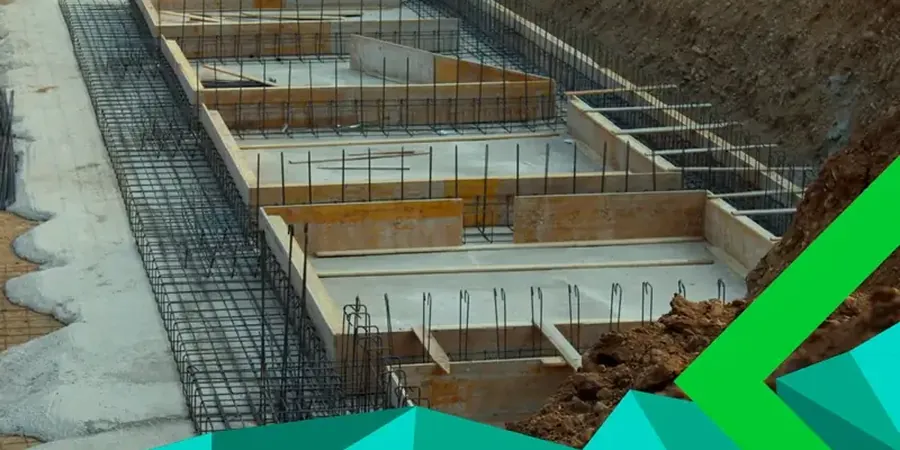
Local considerations
Oakville's development followed the railway and the lake, then pushed northward across increasingly thick glacial deposits. The older southern neighborhoods sit directly on shallow bedrock, where differential settlement between adjacent structures is rarely an issue. The post-1980 expansion north of Upper Middle Road introduced a different risk profile: variable till thickness draped over an irregular shale surface. A shallow foundation placed where till transitions from 1.5 m to 4.0 m thick over a distance of 15 m will experience angular distortion that exceeds the 1/500 limit in NBCC unless the footing design anticipates it. We have observed this exact scenario in the West Oak Trails subdivision, where split-level homes with conventional strip footings required underpinning within ten years. Our designs address the transition zone explicitly, either by deepening the footing to bear on shale where the till thins, or by widening and reinforcing the footing section where the till is too thick to penetrate, with settlement calculations verified against borehole data at each column line.
Applicable standards
NBCC 2020 – Division B, Part 4, bearing resistance and limit states design, CSA A23.3:19 – Design of concrete structures, footing shear and flexure provisions, ASTM D1194/D1194M – Standard test method for bearing capacity of soil in place (plate load test, where specified), Ontario Building Code O.Reg. 332/12 – Division B, Section 9.15 footings, Canadian Foundation Engineering Manual (CFEM) 4th Edition – bearing capacity and settlement calculation procedures
Associated technical services
Bearing capacity and settlement analysis for strip and pad footings
Using log-spiral bearing capacity theory with undrained shear strength from field vane or triaxial tests, combined with Janbu and Schmertmann settlement methods. We provide net allowable bearing pressures for both ULS and SLS conditions, factoring in the depth to the shale contact and the seasonal high groundwater table. Each report includes a footing schedule with width, depth, and reinforcement for every column and wall line.
Construction review and subgrade inspection
Pre-pour inspection of bearing surfaces to confirm the stratum matches the design assumptions. We check for softening in shale, groundwater ingress in till, and any unanticipated fill or organic material in the footing excavation. A stamped field report is issued within 24 hours, allowing the pour to proceed without delaying the project schedule.
Typical parameters
Frequently asked questions
How much does a shallow foundation design package cost for a single-family home in Oakville?
For a typical residential lot in Oakville, the combined geotechnical investigation and shallow foundation design report ranges between CA$2,220 and CA$3,740, depending on the number of boreholes or test pits required and the complexity of the soil profile. A site with shallow, uniform shale will fall at the lower end; a site with deep or variable till requiring multiple boreholes and laboratory testing will be at the upper end.
Do I need a full borehole investigation for a shallow foundation in Oakville, or are test pits enough?
It depends on the depth to competent bearing stratum. In southern Oakville where shale is encountered within 1.2 m, test pits with hand vane and pocket penetrometer readings are often sufficient to confirm bearing capacity. North of the QEW, where till thickness can exceed 3 m, we typically recommend at least one borehole with SPT sampling to characterize the till and confirm the depth to bedrock, because settlement in the till layer often governs the footing design.
What is the typical allowable bearing pressure for strip footings on Halton Till in Oakville?
For stiff Halton Till with undrained shear strength above 75 kPa, net allowable bearing pressures of 100 to 150 kPa are commonly used for strip footings at 1.2 m depth, governed by settlement rather than shear failure. Where the till is denser or contains significant sand and gravel lenses, values up to 180 kPa may be justified with settlement calculations. We determine the final value after reviewing the borehole log, Atterberg limits, and moisture content profile from the specific site.